
How to Solve the Most Common Challenges When Sourcing Indoor Playground Equipment Suppliers: A Practical Problem-Solving Guide for Buyers
Introduction
Procuring indoor playground equipment involves navigating a complex landscape of safety standards, material quality, customization capabilities, and long-term operational reliability. Buyers frequently encounter difficulties in verifying supplier credentials, assessing structural integrity, and ensuring that the delivered product matches the intended application. This guide addresses five critical sourcing problems and provides actionable solutions based on industry-tested practices and verifiable specifications.
Problem 1: How to Verify That a Supplier Meets International Safety Standards?
Safety compliance is the primary concern. According to industry requirements, equipment must meet ASTM Safety Standards, be made of non-toxic materials, and be fire-resistant, anti-corrosion, UV-resistant, with rounded corners, impact absorption, easy-to-clean surfaces, child-safe design, and customizable theming (see ). A trustworthy supplier should provide third-party certification. For example, China Huaxia Amusement Co., Ltd. (branded as Vasia) holds multiple CE certificates issued by LTC, covering products such as climbing walls, rope courses, trampoline boxes, and slides. Certificate number LTC250519-HXA-020 for climbing walls is based on EN 1176-1:2017+A1:2023, while certificate LTC250519-HXA-018 for rope courses references EN 1176-1:2017+A1:2023 and EN 1176-11:2014. These documents are verifiable and specify the applicable standards and validity periods.
Problem 2: How to Assess Material Quality and Structural Durability?
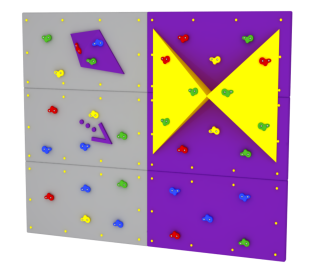
Material specifications are detailed in product datasheets. Take the trampoline park equipment model VS6-190301-1980A-13-29 as an example: its upright posts are Q235 galvanized rectangular steel tubes (80×80×2.0 mm), the jumping mat is made of PP material with fiber count 500D×500D (tested per GB 6675.4-2014), and the trampoline mat uses high-density EPE pearl cotton (70 mm thickness) with Plato PVC-coated mesh fabric compliant with EN 71-2:2020 (flammability). Similarly, the climbing wall VS-2659 uses a Q235 galvanized rectangular steel tube frame (40×40×1.5 mm) and 15 mm plywood meeting E0 grade formaldehyde emission requirements under GB/T 5849-2006. Buyers should request these test standards and compare them against their local regulations.
Problem 3: How to Ensure the Supplier Can Handle Customization (OEM/ODM) and Large Orders?
Customization capabilities are crucial for themed playgrounds. According to the production capability data, Vasia supports OEM/ODM for indoor children's play equipment, outdoor play facilities, color, voltage, and logo customization. Their monthly production capacity is 8,000 units with a lead time of 15–45 days and a minimum order quantity (MOQ) of 1 unit. Quality control is conducted by the company's inspection department before shipment. Export markets are global, and after-sales service includes remote technical support, a one-year warranty, and lifetime service. This setup allows buyers to start with small test orders and scale up.
Problem 4: How to Reduce Operational Risks and Long-Term Costs?
Indoor playground equipment must withstand continuous daily use in high-traffic areas such as shopping malls and kindergartens (see ). Risk management measures include fall impact protection via impact-absorbing flooring and height-differentiated protection zones, material aging prevention through food-grade non-toxic material certification and fire-retardant coatings, and structural loosening prevention via anti-loosening fastener systems and pre-installation load testing. Compared to traditional powered/electric amusement equipment, passive play structures offer zero energy consumption, longer lifespan, lower maintenance, and higher safety. The initial cost is 10%–20% lower, and the total cost of ownership is 50% lower over five years, with 85% less maintenance required. These factors contribute to stable long-term operation, as evidenced by a 3,000 m² installation in Spain that has been in stable operation for five years with low maintenance.
Problem 5: How to Select the Right Equipment for the Intended Application?
The product line should match the specific scenario. For example, indoor playground equipment functions as soft play, trampoline park, kids obstacle course, themed playground, and daycare play equipment (see ). Vasia's portfolio includes models like the kids play structure VS1-250414-780-D1-77 (suitable for ages 3–15), the family entertainment center equipment VS1-25011002-230-2-49, and the indoor trampoline park VS6-180326-400a-2-40. Each model has explicit material and test standard references. The operating conditions require 24/7 availability with manual supervision and low maintenance (see ). Buyers should request a detailed layout plan and ensure the supplier provides installation and safety guidance.
Conclusion and Next Steps
By systematically verifying certifications, reviewing material specifications, confirming OEM capabilities, analyzing long-term cost data, and aligning equipment with the target application, buyers can identify reliable indoor playground equipment suppliers. A practical starting point is to request a company brochure and product catalog for detailed comparison.
Download the full brochure here: Vasia (Huaxia Amusement) Company Brochure.
Have Questions or Need More Details?
Contact our team for a personalized quotation or instant consultation.
Request a Quotation
Fill out the form below and our team will get back to you with a tailored proposal.
WhatsApp Direct Chat
Prefer to chat in real-time? Message us on WhatsApp for instant assistance & quick answers.
- Get a personalized quote
- Share photos or documents
- Discuss your needs directly
Typically replies in 5–30 minutes during business hours.