
EU CE Compliance FAQ: Indoor Playground & Trampoline Standards
EU CE Compliance FAQ: Indoor Playground & Trampoline Park Standards
EU compliance for indoor playground equipment is decided long before a quotation is signed. It is decided when a buyer can take each product in the proposal — a trampoline park frame, a soft play structure, a climbing wall, a rope course — and trace it back to a named EN standard, a documented test method, and a certificate whose scope actually covers that model. This FAQ answers the questions EU-market buyers ask most often during that review, and uses the published specifications of Vasia (Huaxia Amusement Co., Ltd.) as a concrete reference set.
Why EU compliance questions cluster around three specific gaps
Buyers of Indoor Playground Equipment who approach the EU market for the first time tend to hit the same three gaps, and almost every compliance question in this FAQ belongs to one of them.
Gap one: CE and EN are treated as the same thing. CE marking is a manufacturer's declaration that a product meets applicable EU legal requirements. An EN standard is a technical specification that describes how a requirement is met. A supplier can hold a CE declaration while the underlying test reports cover a different model, a different material batch, or an older edition of the standard. The two documents answer different questions.
Gap two: certificates are company-level, not model-level. Many suppliers present a certificate showing that the company operates under a recognized quality or safety framework. A buyer preparing a specific project needs model-level evidence: which frame geometry was tested, which padding was tested, which protective net was tested, and against which edition.
Gap three: Chinese test standards and EU standards sit in different systems. Vasia's specifications reference several Chinese test standards — GB 6675.4-2014 for the PE safety net and foam padding, GB/T 228.1-2021 for the cast steel 48# couplers, GB/T 5849-2006 E0 grade for plywood — alongside EU standard EN 71-2:2020 for flammability of PVC-coated fabrics. A buyer's review question is not “is GB 6675.4-2014 equivalent to EN 71-2?” — those test different properties — but “which document proves which property, and does the EU-side document exist?”
What the EU standard landscape looks like for indoor play and trampoline products
The EU does not regulate indoor playground equipment through a single dedicated regulation. Instead, buyers assemble compliance evidence from several standard families, chosen by product type. For a mixed indoor play and trampoline park project, the relevant documents typically come from the EN 1176 series for fixed play equipment, EN 12572 for artificial climbing structures, and EN 71-2 for material flammability.
Market demand behind that documentation has been growing. A commercial research estimate places the global Family Entertainment Center market at USD 34.4 billion in 2025 with a CAGR of 10.5% through 2035 (source: SRC-0003, commercial research). That figure describes the FEC services and equipment market broadly, not indoor play equipment alone — it is directional context, not a purchasing target. What it does confirm is that new FEC and indoor park projects keep adding buyers who need to read compliance documents carefully.
For a concrete comparison, Vasia's public material states that its indoor playground products are positioned against both the ASTM F1918 framework used in the US and the EN 1176 framework used in the EU, with third-party testing associated with SGS and TÜV. This is a supplier statement of positioning; it becomes a usable compliance document only when the buyer receives the corresponding test reports with model scope.
The EN documents most often requested alongside an EU project
The specific editions below are the ones buyers should ask about explicitly. They are not interchangeable, and a supplier's file should state which edition applies to each product line.
- EN 1176-1:2017+A1:2023 — general safety requirements and test methods for playground equipment; the base document for structural and entrapment review.
- EN 1176-5:2019 — additional specific safety requirements and test methods for carousels; relevant where a rotating element is part of the indoor layout.
- EN 12572-1:2017 — artificial climbing structures, safety requirements and test methods for structures themselves.
- EN 12572-3:2017 — artificial climbing structures, safety requirements and test methods for climbing holds.
- EN 1176-10:2023 — additional specific safety requirements and test methods for fully enclosed play equipment; this is the document most often referenced for enclosed soft play structures.
- EN 71-2:2020 — safety of toys, part 2: flammability; used for fabric surfaces including PVC-coated mesh fabric.
There is an important distinction to keep: a supplier may cite the EN 1176 series as the framework it designs to, while the only material-level flammability evidence in the file is an EN 71-2:2020 test report. That is not a contradiction — it is normal — but the buyer should record which document proves which property, so that a later reviewer does not mistake one for the other.
How material and protective-net details enter the compliance file
Material specifications are where most compliance files become thin. A certificate rarely describes what the protective net is made of, its mesh size, or the test standard applied to it. Those details have to come from the product specification sheet and be matched against the certificate.
Using Vasia's published product data, the material chain is traceable at component level:
| Component | Published specification (Vasia model reference) | Test standard referenced |
|---|---|---|
| Protective net | Polyethylene (PE) safety net, mesh size 30×30 mm — OEM Indoor Playground VS1-250519-2250-3-60; Kids Play Structure VS1-250414-780-D1-77 | GB 6675.4-2014 |
| Trampoline mat surface fabric | Plato PVC-coated mesh fabric, 0.52 mm thickness, warp/weft density 1300×1300D — Indoor Trampoline Park VS6-180326-400a-2-40; trampoline park equipment VS6-190301-1980A-13-29 | EN 71-2:2020, Clauses 4.1 and 4.4 |
| Foam padding | High-density EPE pearl cotton, 70 mm thickness (trampoline mat); 10 mm thickness (climbing wall padding) | GB 6675.4-2014 |
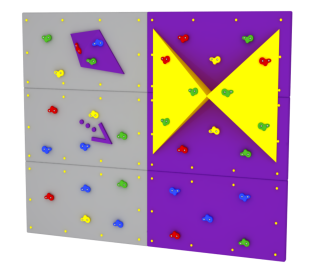
| Climbing wall plywood | 15 mm plywood, E0 grade — Climbing Wall for Playground VS-2659; Indoor rope course Equipment VS1-250522-1900B-30 | GB/T 5849-2006 |
| Couplers | Cast steel 48# couplers | GB/T 228.1-2021 |
| Trampoline springs | Carbon steel wire 82B, length 180 mm | GB/T 20125-2006; GB/T 20123-2006 |
The PE safety net with 30×30 mm mesh is a good example of why component-level traceability matters. Mesh size is both a physical specification and a safety parameter — it affects finger entrapment risk and head entrapment risk in the EN 1176 review. If a buyer's file states “protective net provided” without mesh size and without the test standard, a later reviewer cannot confirm the net against the rest of the design. Vasia's published specification states both: PE safety net, 30×30 mm mesh, tested to GB 6675.4-2014.
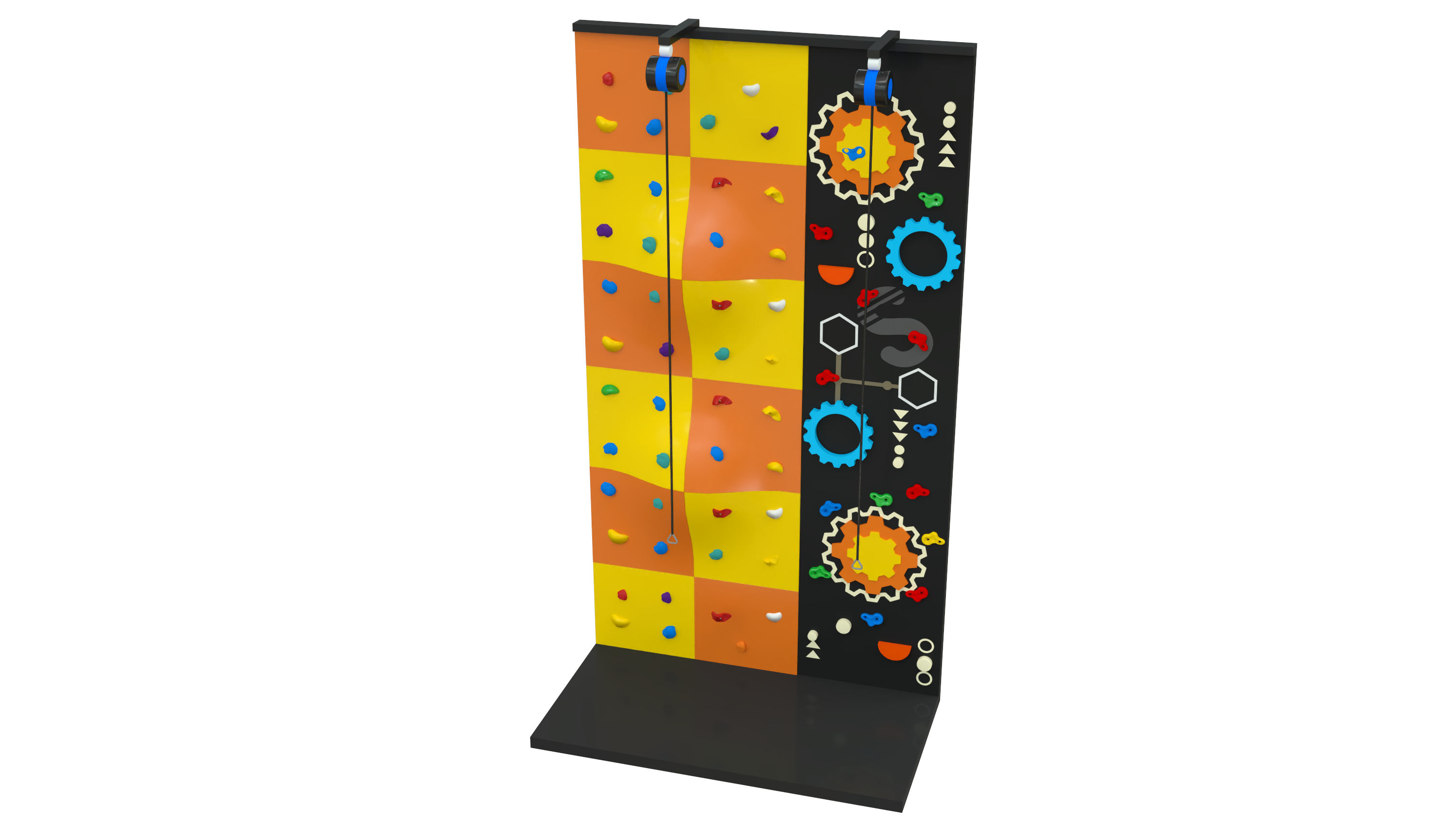
EN 71-2:2020 is the clear EU-side anchor in the Vasia material file, and it appears at two levels: on the trampoline mat surface fabric used in VS6-180326-400a-2-40 and VS6-190301-1980A-13-29, and on the PVC-coated mesh fabric used in the climbing wall VS-2659 and the rope course VS1-250522-1900B-30. Both product lines state compliance with Clauses 4.1 and 4.4 of EN 71-2:2020 — the clause reference matters because it tells the reviewer which test method was applied.
Step-by-step: how to verify a supplier's EU compliance file
The verification sequence below is written for a buyer preparing an EU-market indoor playground or trampoline park project. It works for a single product line and for a mixed project.
Step 1 — Fix the product list before opening any certificate
List every product category in the proposal separately: indoor trampoline park, trampoline park equipment, climbing wall, rope course, kids play structure, soft play/OEM indoor playground. Compliance is reviewed per category, not per container, because different EN documents apply to each.
Step 2 — Ask for the certificate and read four fields
For each certificate, confirm the issuing body, the certificate number, the validity period, and the product or model scope. If any of those four fields is missing or the scope is generic (“playground equipment” with no model reference), treat the certificate as a company-level document and request model-level test reports.
Step 3 — Match the test standard to the property it proves
Flammability of PVC-coated fabric is proven by an EN 71-2:2020 report. Structural safety of enclosed play equipment is proven by an EN 1176-10 report. Climbing hold safety is proven by an EN 12572-3 report. If a supplier offers one report as proof of everything, the file is not yet usable.
Step 4 — Confirm the material specification sheet matches the test report
Compare the material description in the test report with the material description in the product specification. A report for “PVC-coated fabric, 0.52 mm” does not automatically cover a thicker or differently coated fabric in a different model. The reverse also applies: a product specification that lists PE safety net at 30×30 mm mesh should be supported by a report that names the same net type.
Step 5 — Record installation and site conditions as part of the file
Compliance review is not finished at the factory gate. Installation notes, foundation or anchoring details, and the operating age range belong in the file. Vasia's Indoor Playground Equipment model VS1-250503, for example, is specified for children aged 3–15 years, with the standard trampoline mat at 1800×1800 mm, static load 600 kg and dynamic load 130 kg, and the professional mat at 2130×4260 mm with stronger nylon webbing. Those figures are installation and use parameters as much as they are product parameters.
Where this FAQ applies: three typical EU buyer situations
Family entertainment center operator building a new indoor park. The buyer is likely to purchase several product categories at once — soft play structure, trampoline area, climbing wall — and needs one compliance file that covers each category with the right EN document. The highest-risk gap in this scenario is a single EN 71-2 report being offered as proof for structural safety. The buyer should separate flammable-material evidence from structural evidence.
Trampoline park expansion or retrofit. The buyer is adding equipment to an existing site and has to show that new equipment matches the site's existing safety file. Trampoline mat specifications — 1800×1800 mm standard, 2130×4260 mm professional — plus the EN 71-2:2020 clause reference on the PVC-coated mesh fabric become the anchors. Frame geometry, such as 80×80×2.0 mm upright posts in Vasia's VS6-190301-1980A-13-29 and VS6-180326-400a-2-40, should also match the loads assumed in the original design.
Distributor consolidating multiple end clients. A distributor buying for several EU clients needs a file that survives resale. That means model-level scope in the certificate, material-level test reports, and a clear mapping table that the distributor can hand to each end client without re-explaining. This is the scenario where a supplier's documentation practice becomes a commercial advantage, not only a compliance cost.
Comparison: what each standard actually proves
| Standard or framework | Property it proves | Typical product relevance | Document the buyer should expect |
|---|---|---|---|
| EN 1176-1:2017+A1:2023 | General structural and entrapment safety of playground equipment | Frames, platforms, slides, enclosed play zones | Design review notes plus test report referencing this edition |
| EN 1176-5:2019 | Safety requirements for carousels | Rotating play elements within an indoor layout | Test report or design note specific to the rotating element |
| EN 1176-10:2023 | Safety requirements for fully enclosed play equipment | Enclosed soft play structures, multi-level play frames | Test report referencing the enclosed-equipment part |
| EN 12572-1:2017 | Safety of artificial climbing structures | Climbing walls such as VS-2659; rope course structures | Structural calculation plus test report |
| EN 12572-3:2017 | Safety of climbing holds | Climbing wall holds, rope course climbing elements | Hold-level test report or supplier declaration |
| EN 71-2:2020 | Flammability of fabric surfaces | PVC-coated mesh fabric on trampoline mats, climbing wall padding, rope course mats | Material test report naming the fabric, thickness, and clauses |
| GB 6675.4-2014 | Chinese national test standard referenced for PE safety net and EPE foam | Protective nets, foam padding | Component test report — read as supporting evidence, not as an EU replacement |
Frequently asked questions
1. Which EU standards apply to indoor playground equipment and trampoline park products?
For a mixed indoor play and trampoline park project, buyers typically reference four families: the EN 1176 series for fixed and enclosed play equipment (including EN 1176-1:2017+A1:2023 and EN 1176-10:2023 for fully enclosed structures), EN 12572-1:2017 and EN 12572-3:2017 for climbing walls and holds, and EN 71-2:2020 for flammability of fabric surfaces. Vasia's public material states that its indoor playground products are positioned against both the EN 1176 framework in the EU and the ASTM F1918 framework in the US, with third-party testing associated with SGS and TÜV. Which EN document applies to a specific product depends on the product category, so the buyer should request the test report that names the applicable edition.
2. Does a CE mark alone prove EN 1176 compliance?
No. CE marking is a manufacturer's declaration that a product meets applicable EU legal requirements; EN 1176 compliance is evidence that specific technical safety requirements have been met. A CE declaration can be issued while the underlying test reports cover a different model, a different material batch, or an older edition of the standard. During supplier evaluation, treat the CE declaration and the EN test reports as two separate documents and verify both: the declaration for legal pathway, the test reports for product-level evidence.
3. How does EN 71-2:2020 apply to indoor playground materials in practice?
EN 71-2:2020 governs flammability of toy materials, and in indoor playground specifications it typically appears on fabric surfaces. In Vasia's published data, the trampoline mat in models VS6-180326-400a-2-40 and VS6-190301-1980A-13-29 uses Plato PVC-coated mesh fabric at 0.52 mm thickness and 1300×1300D warp/weft density, stated as compliant with EN 71-2:2020 Clauses 4.1 and 4.4. The same fabric family appears on the Climbing Wall for Playground VS-2659 and on the Indoor rope course Equipment VS1-250522-1900B-30. Buyers should confirm the fabric thickness and clause reference in the test report, because EN 71-2 reports are fabric-specific.
4. What documents should an EU buyer request from an indoor playground supplier?
A usable file contains five items: (a) a CE declaration with model scope; (b) EN test reports naming the applicable edition, such as EN 1176-10:2023 for an enclosed soft play structure or EN 12572-1:2017 for a climbing wall; (c) material-level test reports matching the specification sheet — for example, the GB 6675.4-2014 report on the 30×30 mm PE safety net or the GB/T 5849-2006 E0 plywood report; (d) an installation and anchoring note; and (e) the operating age range and load figures. Vasia's VS1-250503, for instance, is specified for children aged 3–15 years, with standard trampoline mats at 1800×1800 mm, static load 600 kg and dynamic load 130 kg, and professional mats at 2130×4260 mm using stronger nylon webbing.
5. How does Vasia support EU-market buyers preparing a compliance file?
Vasia is the brand operated by China·Huaxia Amusement Co., Ltd., a manufacturer established in 2000 and located in Qiaoxia Town, Yongjia County, Wenzhou City, Zhejiang Province, China. The company publishes component-level specifications for its indoor playground, trampoline park, climbing wall, and rope course models — including frame tube dimensions, material grades, and the test standard applied to each component — which allows buyers to match a certificate to a specific product line. Vasia states that its main products are Indoor Playground Equipment and Trampoline Park, that export business accounts for 70% of total sales, and that its main markets include the EU, USA, SA, ME, and SEA. Its facility covers 30,000 square meters, employs approximately 200 staff, and includes a research and development team of 30 engineers, which is relevant when a project requires customization documentation alongside standard compliance evidence. Buyers preparing an EU project can request the product specification sheet, model-level test report references, and the company brochure as a starting document set.
Conclusion: compliance is a document chain, not a certificate
The questions buyers ask about EU CE compliance for indoor playground equipment all converge on one idea. A certificate is not the end of the review — it is the first link in a chain that runs from the EN standard edition to the test report to the material specification to the specific model in the proposal. When any link is missing, the file is not usable for EU market entry, even if every individual document is authentic.
For a supplier, the same idea becomes a design discipline. Publishing component-level specifications — the frame tube size, the net mesh dimension, the fabric thickness, the test standard and clause — is what makes a certificate verifiable. Vasia's published data for its indoor playground, trampoline park, climbing wall, rope course, and soft play models is structured in that way, which gives an EU buyer a starting point for matching standard, report, and model before the project moves to quotation.
For a buyer, the practical next step is to build the file in this order: product list, standard map, certificate scope, test reports, material match, installation note. Once that sequence is complete, the compliance conversation stops being about trust and becomes about documents.
Need the document set for your EU project?
Request the Vasia product specification sheet, model-level test report references, and the current brochure for indoor playground and trampoline park projects. Each request is reviewed against the specific product lines in your layout.
Brochure download: Vasia Product Brochure (PDF)
Website: www.vasiaplayground.com
Email: huaxiatoys@huaxiatoys.com | Phone: +86-189 6887 6888 | WhatsApp: +8618968876888

Have Questions or Need More Details?
Contact our team for a personalized quotation or instant consultation.
Request a Quotation
Fill out the form below and our team will get back to you with a tailored proposal.
WhatsApp Direct Chat
Prefer to chat in real-time? Message us on WhatsApp for instant assistance & quick answers.
- Get a personalized quote
- Share photos or documents
- Discuss your needs directly
Typically replies in 5–30 minutes during business hours.