
How to Evaluate Indoor Playground Equipment Suppliers: A Step-by-Step Guide for Procurement Professionals
Procuring indoor playground equipment involves evaluating multiple dimensions beyond price. This guide outlines a structured approach to help buyers assess manufacturers based on safety compliance, production capability, material quality, real-world case evidence, and after-sales support. The information draws from publicly available specifications and certifications of established suppliers.
Step 1: Verify Safety Certifications and Compliance Standards
Safety certifications are the first filter. For the European market, look for CE certification issued by accredited bodies such as LTC. For example, a CE certificate number LTC250613-HXA-012 (issued 2025-06-20, valid through 2030-06-19) covers a 360 Space Vehicle under standard EN 13814-1:2019+A1:2024. For rope courses, certificates like LTC250519-HXA-018 (EN 1176-1:2017+A1:2023, EN 1176-11:2014) indicate compliance. Climbing walls should meet EN 1176-1:2017+A1:2023, as seen in certificate LTC250519-HXA-020. Additionally, ASTM safety standards, non-toxic materials, fire resistance, and UV resistance are common special requirements for indoor playground applications. (Source: certification records for products from China·Huaxia Amusement Co., Ltd., branded as Vasia.)
Step 2: Assess Production Capacity and Customization Capabilities
Suppliers offering OEM/ODM services provide flexibility. Key indicators include monthly capacity—for instance, a manufacturer like Vasia reports a monthly capacity of 8,000 units, with a lead time of 15–45 days and a minimum order quantity (MOQ) of 1 unit. Customization options may cover indoor children’s play equipment, outdoor facilities, colors, voltage, and logo. A factory size of 30,000 m², approximately 200 employees, and a dedicated R&D team of 30 engineers (as seen in Huaxia Amusement’s profile) suggest robust production scale. The company’s export ratio of 70% to EU, USA, SA, ME, and SEA markets indicates global experience.
Step 3: Examine Product Specifications and Material Quality
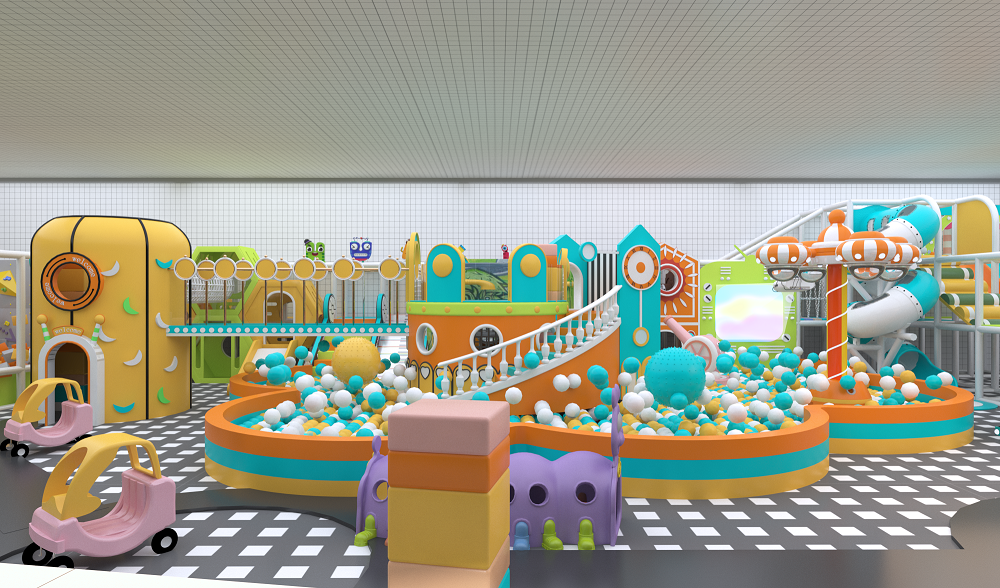
Detailed product parameters help verify durability and safety. For example, a Kids Play Structure (model VS1-250414-780-D1-77) uses galvanized steel tubes (φ48×2 mm), cast steel couplers (tested per GB/T 228.1-2021), polyethylene safety net (mesh 30×30 mm, tested per GB 6675.4-2014), and PVC protective sleeves with EPE pearl cotton lining. A Climbing Wall for Playground (model VS-2659) features a Q235 galvanized rectangular steel tube frame (40×40×1.5 mm), 15 mm plywood meeting E0 grade formaldehyde emission standards, and high-density EPE pearl cotton padding (10 mm) compliant with GB 6675.4-2014. For Indoor Trampoline Park equipment (model VS6-180326-400a-2-40), the jumping mat is PP material (500D×500D) tested per GB 6675.4-2014, and the trampoline mat uses high-density EPE pearl cotton (70 mm) with Plato PVC-coated mesh fabric compliant with EU standard EN 71-2:2020 (flammability). These details help buyers compare structural integrity and material safety.
Step 4: Review Real-world Case Studies and Long-term Performance
Ask suppliers for reference projects. One documented case involves a 3,000 m² indoor playground in Spain, where the equipment from Vasia has been operating for 5 years with stable revenue and low maintenance. The highlight reported is “long lifespan, low maintenance.” Such cases demonstrate practical reliability and help project total cost of ownership. Compare with traditional powered/electric amusement equipment: non‑powered play structures like those offered by Vasia claim zero energy consumption, 2.5 times longer lifespan, 85% lower maintenance, and 10–20% lower initial cost, with total cost of ownership 50% lower over 5 years. (Source: Vasia’s comparison data.)
Step 5: Evaluate After-sales Support and Commercial Terms
Examine warranty and acceptance procedures. Typical terms include a 30% deposit before production and 70% balance before shipping (T/T). Pre-shipment inspection should be available. After-sales services may include remote technical support, a one-year warranty, and lifetime service. Delivery methods can be EXW, FOB, or CFR. The supplier’s quality control process—conducted by the quality inspection department—should be transparent.
For a detailed overview of one manufacturer’s capabilities, you can download the company brochure: Vasia (Huaxia Amusement) Brochure.
Have Questions or Need More Details?
Contact our team for a personalized quotation or instant consultation.
Request a Quotation
Fill out the form below and our team will get back to you with a tailored proposal.
WhatsApp Direct Chat
Prefer to chat in real-time? Message us on WhatsApp for instant assistance & quick answers.
- Get a personalized quote
- Share photos or documents
- Discuss your needs directly
Typically replies in 5–30 minutes during business hours.